

Mastitis costs U.S. dairy producers between $326 and $427 per clinical case, with subclinical infections adding over $1 billion in annual losses across the industry. For dairy operations managing tight margins, mastitis prevention is the difference between profitability and loss.
This guide examines the top iodine-based sanitizers for mastitis prevention, the science behind iodine’s effectiveness and the products that deliver proven pathogen control. You’ll find practical guidance on how iodine-based solutions reduce infection rates, protect herd health and support cost-effective dairy operations.
Mastitis remains the most economically damaging disease affecting U.S. dairy cows. Subclinical mastitis adds over $1 billion in annual losses to the U.S. dairy industry, with production losses averaging $110 per cow annually.
Contagious pathogens like Staphylococcus aureus and Streptococcus agalactiae spread cow-to-cow during milking operations. The milking machine serves as the primary transmission vector, transferring bacteria from infected teats to healthy ones. Environmental pathogens like coliforms and environmental streptococci add additional risk through contact with contaminated surfaces and bedding.
Teat disinfection offers better cost control than treating infections after they develop. Antibiotic use is reduced, milk quality is maintained and herd productivity is protected. Smart mastitis prevention in dairy cattle starts with choosing effective iodine disinfectants and implementing consistent application protocols.
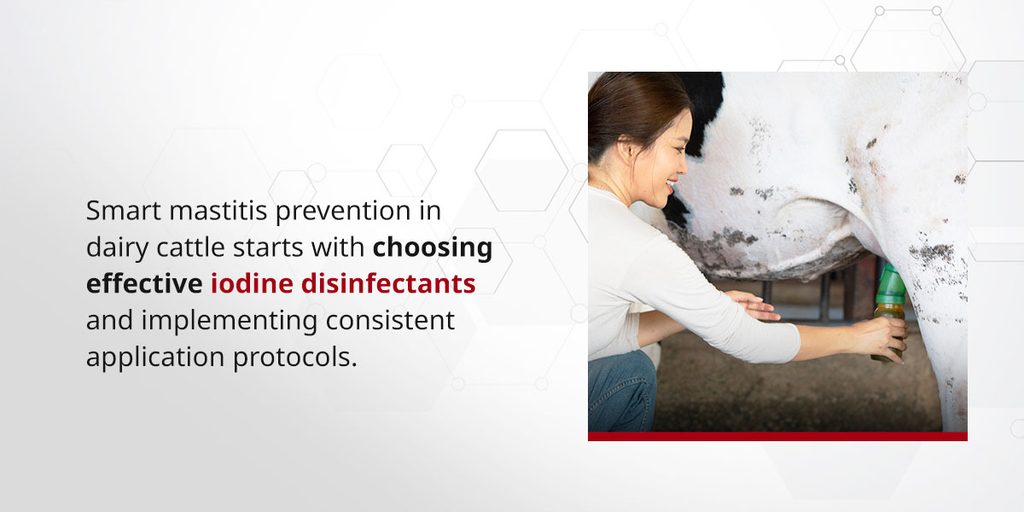
Iodine works differently from other antimicrobial agents by penetrating bacterial cell walls and disrupting multiple metabolic pathways simultaneously. This multi-pathway attack makes it highly improbable for pathogens to develop resistance, unlike the challenges often seen with antibiotics. Iodine kills bacteria rather than simply inhibiting growth, making it a true biocidal agent.
Post-milking teat disinfection reduces new intramammary infections by 70% or more compared to no disinfection, while iodine delivers broad-spectrum coverage against bacteria, viruses, fungi and spores. This makes it effective against contagious pathogens like Staph. aureus and Strep. agalactiae, as well as environmental organisms. Iodophor-based teat disinfection has demonstrated consistent efficacy against contagious mastitis pathogens.
Elemental iodine presents one challenge — poor water solubility. Effective dairy applications require specialized formulations using complexing agents or chemical carriers. These formulations deliver stable, consistent iodine release for reliable pathogen control. They are the foundation for bovine udder health management programs.
Three specialty iodine chemicals are the foundation for teat sanitizer formulations. These products address the complete disinfection pipeline, from raw ingredient sourcing to finished product manufacturing.
Hydriodic acid is the chemical building block for potent, stable iodine disinfectant formulations. This aqueous solution of hydrogen iodide (CAS: 10034-85-2) functions as a strong acid effective at eliminating bacteria.
Hydriodic acid provides superior iodine solubility compared to elemental iodine. It enables stable, concentrated disinfectant formulations with consistent active iodine release. Chemical manufacturers use HI to create custom sanitizer blends for milking equipment, parlor surfaces and staff hand or glove disinfection.
Commercial suppliers provide hydriodic acid at research and commercial scale with minimum order quantities of 5kg and a minimum purity of 98%. Vertically integrated supply chains, from domestic iodine extraction to final production, ensure consistent quality and reliable availability. Formulators seeking a consistent HI supply can request product specifications directly.
Iodophor concentrate is the practical application of iodine chemistry in dairy operations. Iodophor combines elemental iodine with a nonionic surfactant or carrier agent. This creates a water-soluble, sustained-release iodine reservoir that delivers consistent pathogen control while conditioning teat and udder skin.
The teat canal remains open for up to one hour after cluster removal. Iodophor teat dip applied immediately after milking kills bacteria before the canal closes, preventing pathogen entry into the udder. This post-milking teat disinfection window is critical for controlling contagious mastitis.
Pre-milking application reduces environmental pathogen load on teat ends before milking begins. The dual-timing protocol addresses different pathogen sources at different points in the milking routine.
Iodophor formulations offer multiple benefits for teat sanitizers for dairy cows:
IODOPHOR COMPLEX 20-23% is a concentrate for further dilution to working concentrations. It gives dairy operations and formulators flexibility in final product preparation.
Hydriodic acid-Iodine Concentrate (HI3) solves the iodine solubility problem at manufacturing scale. This pre-blended solution combines 60-67% iodine with 33-40% hydriodic acid (57%). The typical blend ratio is 63% iodine and 37% hydriodic acid. It appears as a dark reddish-brown viscous liquid with a specific gravity of 2.7 at 20° Celsius.
Teat dip manufacturers use HI3 as a ready-to-formulate ingredient designed specifically for iodophor manufacture for mastitis control in the dairy industry. The pre-optimized iodine-to-hydriodic acid ratio eliminates formulation guesswork, requiring no on-site blending calculations.
Manufacturing benefits include the following:
HI3 ships in HDPE drums at 35 gallons (400 pounds) or 55 gallons (750 pounds), classified as Class 8 Corrosive, UN1787, Packing Group II. Manufacturers can contact suppliers for technical specifications and shipping details.
Mastitis prevention requires controlling pathogens at every transmission point. While teat dipping addresses the cow directly, effective programs also target the equipment, surfaces, water systems and human contact points that spread infection throughout the herd.
Contagious pathogens spread primarily during milking, making equipment disinfection the first critical control point. Iodine-based sanitizers eliminate bacterial transfer between cows through inflations, claws and milk lines.
Between milkings, environmental pathogens accumulate on parlor floors, walkways and contact surfaces. Iodine-based surface biocides reduce this pathogen reservoir and limit cow exposure, working alongside teat disinfection to control environmental sources of mastitis.
Water systems present a less visible but equally important risk. Biofilm in stored water used for udder washing and equipment rinsing can harbor environmental mastitis pathogens. Iodine-based water treatment prevents buildup in storage tanks and distribution lines, supporting overall udder health and milk quality.
The human factor completes the control strategy. Milking staff who contact teats with their hands or gloves can transfer contagious pathogens between cows. Iodine-based hand and glove sanitization closes this often-overlooked transmission pathway.
Smart dairy operations build comprehensive hygiene programs with specialty iodine solutions for animal care and specialty iodine chemicals at the center. This addresses every control point as part of a complete system approach.
Iofina Chemical provides the complete iodine solution pipeline for dairy sanitation. Our three-product lineup — Hydriodic Acid for custom formulations, Iodophor Concentrate for direct applications and HI3 Concentrate for industrial manufacturing — covers each stage of mastitis prevention. Our products are backed by ISO 9001 certification and a vertically integrated supply chain from Oklahoma to Kentucky.
Dairy producers can explore our animal care solutions to learn more. Manufacturers can request product specifications or get in touch with Iofina Chemical for general inquiries. Contact [email protected] or 859-359-6061.