Ethyl iodide is used as an ethylating agent in organic synthesis. Ethylation reactions need a reagent that can transfer an ethyl group cleanly and predictably. Ethyl iodide does this by reacting with nucleophiles through bimolecular nucleophilic substitution (SN2). The nucleophile attacks the ethyl carbon, and iodide leaves as a stable, low-energy leaving group. That reactivity powers several distinct synthetic routes, including ether formation, amine alkylation and organomagnesium and phosphonium chemistry.
Reagent selection still depends on the substrate and the selectivity required by a given synthesis. As a process advances from research to manufacturing, product specifications and order quantities should guide sourcing discussions.
Iodide’s large atomic radius, polarizability and low basicity make it an effective leaving group during bimolecular nucleophilic substitution (SN2). As the nucleophile forms a bond with the ethyl carbon, iodide departs with the electron pair from the carbon-iodine bond. This step occurs without a discrete intermediate, so a single transition state carries the reaction from start to finish. In the SN2 reaction, the nucleophile approaches from the side opposite the leaving group.
An effective leaving group stabilizes the developing negative charge in the transition state, lowering the activation barrier compared with less accommodating leaving groups. Ethyl halides follow a predictable trend. Iodide leaves more readily than bromide, and bromide leaves before chloride. This order helps explain why ethyl iodide can offer greater substitution reactivity than bromoethane or chloroethane.
Its reactivity makes ethyl iodide suitable for SN2 alkylation when a process requires the introduction of an ethyl group at an accessible nucleophilic site. The nucleophile’s structure, competing reactive sites and required selectivity all influence the choice of reagents. Handling requirements and process economics factor into the final reagent decision alongside the chemistry.
Moisture control requirements depend on the reaction, not on ethyl iodide itself. Grignard formation needs anhydrous conditions because water reacts with the organomagnesium product, while other substitution reactions use conditions selected for the nucleophile and substrate.
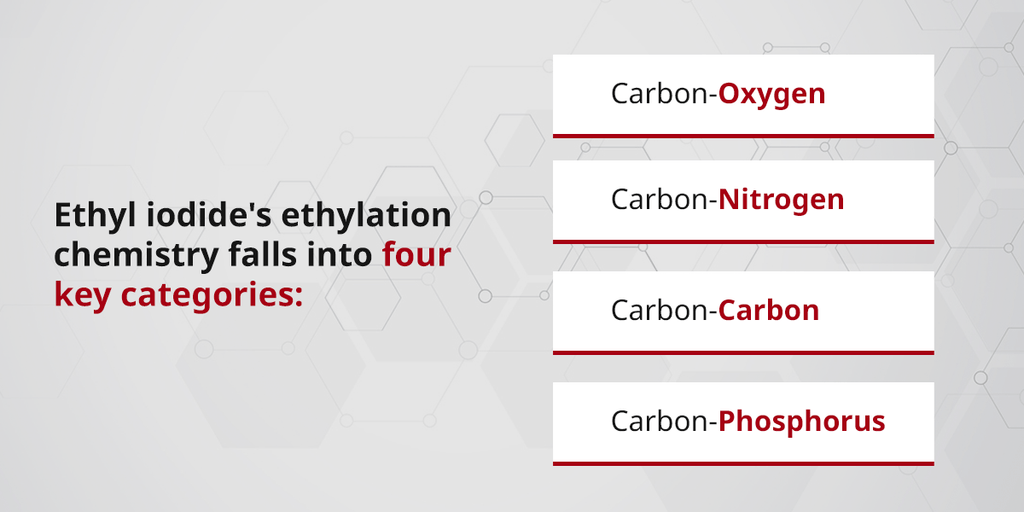
Ethyl iodide’s ethylation chemistry falls into four key categories, based on the type of bond it forms — carbon-oxygen, carbon-nitrogen, carbon-carbon or carbon-phosphorus. Each reaction places the ethyl fragment into a different product or intermediate class. The ethyl iodide synthesis applications below cover the primary ethyl iodide uses in this chemistry.
Williamson ether synthesis uses an alkoxide or phenoxide nucleophile to displace iodide from ethyl iodide and form an ethyl ether. Ethyl iodide provides the ethyl fragment, and its primary carbon provides an accessible site for nucleophilic attack. The resulting carbon-oxygen bond creates an alkyl or aryl ethyl ether, depending on the oxygen nucleophile selected.
Ethyl ethers can function as intermediates in pharmaceutical, agrochemical and specialty chemical synthesis. Williamson ether synthesis uses halogenated hydrocarbons as alkylating agents, with the base, solvent and substrate structure influencing the reaction outcome. Process development must account for competing reactions when the oxygen nucleophile contains more than one active site. Primary alkyl halides such as ethyl iodide are particularly well-suited to this pathway because their unhindered carbon supports bimolecular substitution.
For a target ether, the nucleophile determines which molecular framework receives the ethyl group. This distinction helps establish whether ethyl iodide supplies the required bond connection before condition screening begins.
N-ethylation occurs when an amine nitrogen attacks ethyl iodide’s electrophilic carbon and forms a carbon-nitrogen bond. Primary amines can produce secondary amines as a result of a reaction, and a secondary amine, if it reacts again, gains another ethyl group and becomes a tertiary amine. Nitrogen heterocycles can undergo the same reaction once their N-H site is deprotonated or otherwise activated under the chosen conditions.
Secondary amines formed from a primary substrate often retain enough nucleophilicity to react again. This consecutive alkylation can shift the product distribution away from the intended degree of substitution. Controlling stoichiometry and reaction conditions helps keep the outcome within the targeted amine category, whether that’s a secondary or tertiary product.
Reaction planning considers both the starting amine and the desired substitution level, since each additional ethylation changes the nitrogen environment and the resulting product. The resulting N-ethylated intermediates frequently move into pharmaceutical or agrochemical development, where the added ethyl group can influence a molecule’s activity, solubility or metabolic behavior.
During Grignard reagent preparation, ethyl iodide reacts with magnesium to form ethylmagnesium iodide. The new carbon-magnesium bond gives the ethyl carbon a strong nucleophilic and basic character, turning what was an electrophilic carbon in ethyl iodide into a reactive, carbanion-like center.
Ethylmagnesium iodide reacts with a suitable electrophile to build a new carbon-carbon bond. Reactions with aldehydes or ketones produce magnesium alkoxide intermediates that yield alcohols upon workup. This sequence extends the carbon framework by introducing the ethyl fragment at the former carbonyl carbon.
Water protonates and consumes Grignard reagents, so formation and use require dry equipment, anhydrous materials and protection from atmospheric moisture. Substrate functional groups must remain compatible with the strong basicity and nucleophilicity of the organomagnesium intermediate.
Functional groups containing acidic hydrogens can consume the Grignard reagent rather than participate in the intended carbon-bond formation.
Ethyl iodide reacts with triphenylphosphine in an SN2 quaternization to form ethyltriphenylphosphonium iodide. In this step, phosphorus attacks the ethyl carbon and iodide departs, producing a phosphonium salt with an acidic hydrogen on the charged phosphorus center.
Treatment with a suitable strong base removes that hydrogen and forms the phosphorus ylide used in the Wittig reaction. The ylide functions as the Wittig reaction reagent by reacting with a carbonyl compound to form an alkene, replacing the carbonyl oxygen while establishing a new carbon-carbon bond.
Ethyl iodide, therefore, contributes to Wittig reagent preparation by building the carbon-phosphorus bond in the phosphonium salt precursor. Its role occurs upstream of the carbonyl transformation, distinguishing the route from Grignard chemistry through both the reactive intermediate it generates and the mechanism used to form the final carbon-carbon bond.
Iofina uses a vertical integration model that connects iodine extraction at Iofina Resources with iodine derivative manufacturing at Iofina Chemical. This relationship provides buyers with a point of contact for discussing ethyl iodide requirements and the supply considerations affecting their programs.
Ethyl iodide is available with a minimum purity of 98% and a minimum order quantity of five kilograms (11 pounds). Research and procurement teams can request a quote with specifications, required quantities, availability, lead times and shipping. Contact us today to discuss your needs and how we can help.